A practical comparison of Oscilar and Taktile for credit risk decisioning — written from the trenches, not a product brochure.
Disclosure
I initially conducted this deep-dive as a private field report in January 2026 for my advisory firm, Sirius Nav, to determine which platform truly closes the loop between decisioning and fast iteration. After sharing the results with both teams, I was so impressed with Oscilar’s trajectory that I recently joined them as a Decision Architect to help shape their credit risk and AI roadmap.
Despite my current affiliation, this comparison remains a practitioner’s honest look at the in-the-trenches reality of both tools. I’ll tell you where Taktile wins too.
Background: The Bottleneck Moved
Over the past decade, credit risk modeling evolved from linear regression to sophisticated ML models, and modeling languages shifted from SAS to R to Python. The models became more powerful — but surprisingly, the time to build one shrank. Standardized packages matured. What used to take months now takes weeks.
And yet the frustration never went away.
Why? Because the bottleneck wasn’t the model. It was everything around it.
Around 60–70% of data scientist time was spent on historical data preparation during model building. And if new integrations were needed on the Engineering side — a new data provider, a new signal — model implementation could easily exceed model building time. Most data scientists weren’t building models. They were getting data ready and getting models into production.
That’s the pain modern decisioning platforms are built to solve. Over the past year, I’ve worked hands-on with both Oscilar and Taktile — two of the leaders in this space. This is my honest breakdown.
Where They’re the Same
Both platforms are genuinely strong, backed by excellent Solution Engineering teams. At their core, they share the same foundational feature set:
- Flowchart UI — Translate business rules into a visual decision flow, with support for custom ML model nodes.
- Traffic splitting and shadow testing — Run in shadow mode or split live traffic across different decision flow versions with configurable percentages.
- Data connectors — Integrate internal data sources and external data vendors (KYC, bureau data, fraud signals) with minimal engineering effort.
- Decision storage — Every production decision is stored with its full input/output context and logic, queryable via API for compliance or analytics.
If your requirements end here, either platform will serve you well. The real differences emerge when you start asking deeper questions about your decisions.
Decision Flow UI: A Slight Edge for Taktile
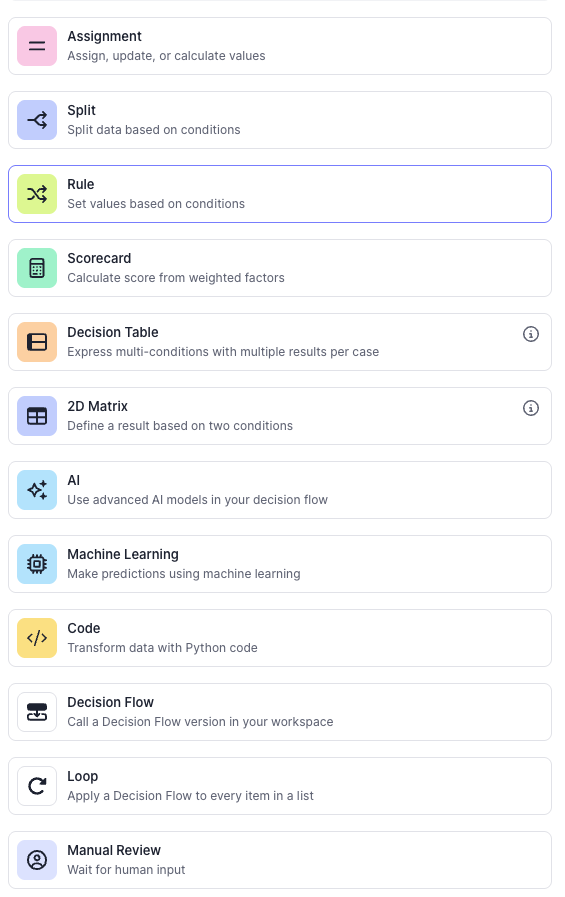
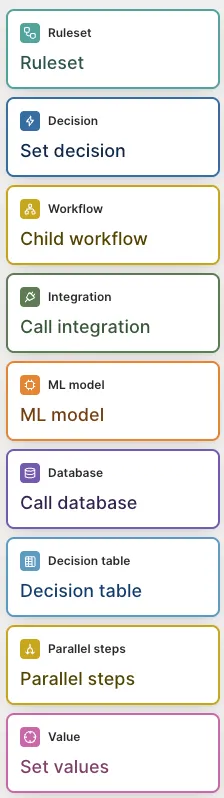
Both platforms use a similar palette of components. The add/edit/delete experience is largely equivalent. Where Taktile pulls ahead is in contextual guidance: each component shows a brief inline description, and complex nodes like the Decision Table link directly to documentation with examples.
Slight edge to Taktile — inline documentation at every component makes onboarding faster and reduces context-switching for new team members. Both platforms are excellent; this is a friction point, not a gap.
Oscilar’s component set is purposefully consolidated — supporting scorecards, custom Python, and complex built-in functions — but its help documentation sits outside the flow. A minor friction point when onboarding new team members.
Product Philosophy: Two Different Bets
The design differences reflect fundamentally different philosophies about who the primary user is.
Taktile — “Simplify decision orchestration”
Each component handles one specific function. It’s highly visual and step-by-step. When flows grow complex, they have more nodes — but components can be grouped for cleaner visualization. Advanced data handling requires Python, and their AI copilot is effective at writing it. The platform rewards engineers and analysts who want granular control.
Oscilar — “Empower non-technical decision makers”
An AI agent translates business rules into a V0 decision flow automatically. Powerful built-in functions read like advanced SQL — covering arrays, geolocation, and aggregations — with a syntax closer to plain English than code. For anything not covered by built-in functions, Python is still an option. The platform is designed for decision makers who want depth without a code dependency.
Neither is objectively better. The right choice depends on whether your team is analyst-centric or decision-maker-first.
A Real-World Example: Same Logic, Two Approaches
Consider a common risk task: parse thousands of transaction records to flag disputed transactions, then attach a deny reason.
In Oscilar, one node handles it — built-in functions extract from the transactions array and construct the deny reason in a single step:
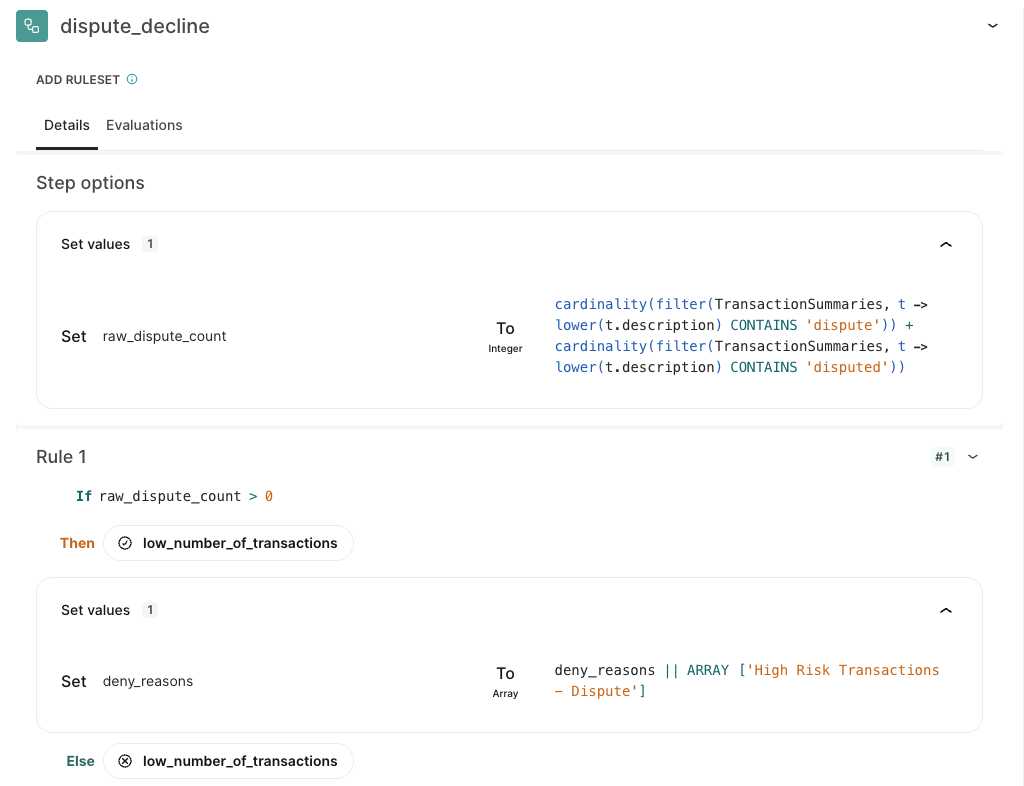
In Taktile, the same outcome requires two separate nodes:
Step 1 — A Python script to parse disputed transactions:
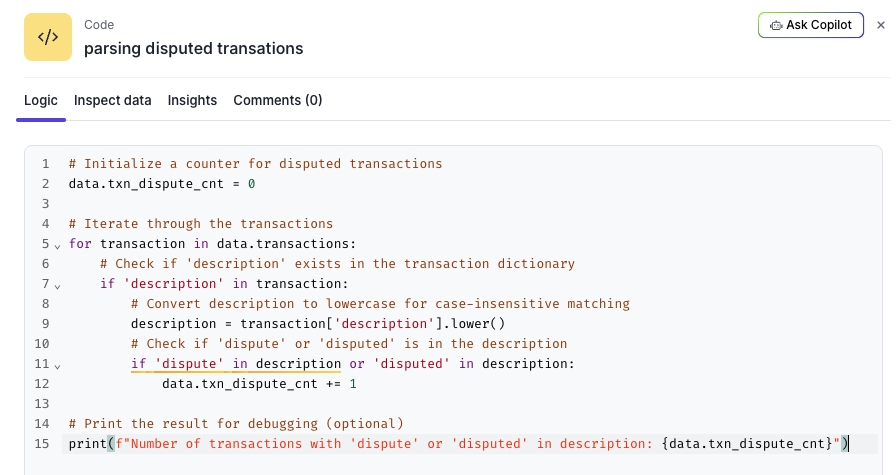
Step 2 — A rule node to assign the deny reason:
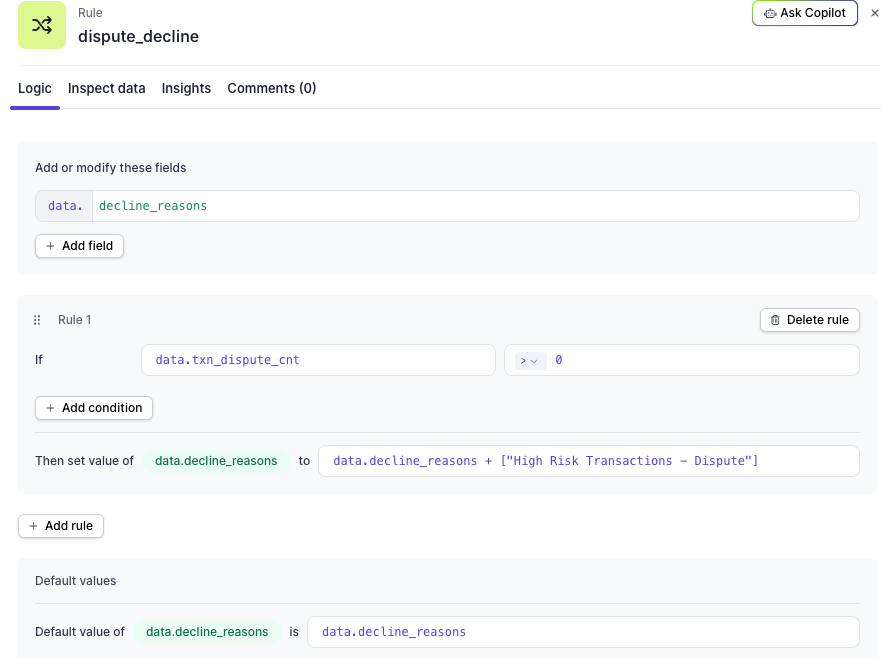
Neither approach is wrong. But multiply this pattern across a complex decisioning flow and the operational difference becomes meaningful.
Analytics: Where the Real Gap Opens
This is where the platform choice becomes a strategic one.
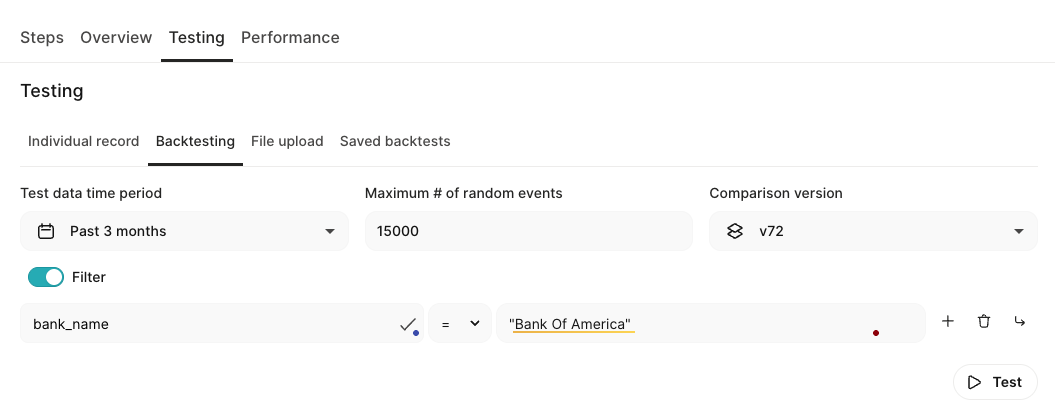
Both platforms store every production decision. But how you get insight from those decisions is where Oscilar separates itself.
A note on analytics scope: Oscilar’s in-platform analytics is decision-level analytics — it’s not a replacement for a full BI suite like Looker or Tableau. But for the feedback loop that matters most in decisioning (are my rules working, where should I iterate?), it’s exactly the right layer. The fact that the same built-in functions power both live decision flows and analytical queries means there’s no translation layer between production logic and analysis.
Scorecard
The Verdict
If you want a highly polished, code-friendly orchestrator with excellent UX, Taktile is a formidable contender with a bright future. Teams that prioritize clean visual orchestration, or that already have a strong off-platform analytics stack, will find it compelling — and as their analytics capabilities mature, the gap will narrow.
But if your team’s primary question is “are our decisions working, and where should we iterate?” — Oscilar is the stronger choice today. Its A/B testing, backtesting, and analytics layer turns a decision engine into a decision intelligence system. That’s the difference between operating decisions and learning from them.
The strategic question isn’t which platform could modernize your existing decisioning process. It’s which one helps your risk team build intelligence over time.
That answer is Oscilar — today.
Orion Zhao is a Decision Architect at Oscilar and founder of Sirius Nav, an advisory firm focused on credit risk and AI strategy. This review was originally conducted as an independent field report in January 2026.